
Finding Value Where It’s Overlooked
Value Is Hiding in Plain Sight
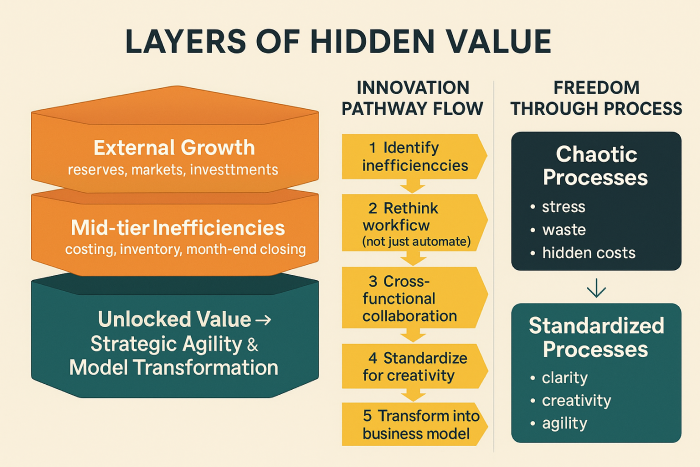
In almost all industries, executives often look outward for growth—new reserves, new markets, new investments. But many overlook what’s right in front of them: untapped value trapped in broken, outdated, or overly complex business processes. Before you search for external breakthroughs, it’s time to look inward—for the inefficiencies and friction points silently draining margin, uptime, and agility.
Process Innovation ≠ Process Automation
Too many transformation efforts confuse automation with innovation. They digitize manual tasks but fail to question whether the process itself is worth keeping. Automating a broken maintenance cycle or cost-tracking workflow simply scales dysfunction. True innovation means rethinking how work should happen—from zero—then designing systems to support it. It’s not about faster input; it’s about smarter flow.
Where Innovation Often Hides: The Mid-Tier Core
Mid-tier processes are where inefficiencies often go unnoticed—neither obvious in executive strategy nor visible in frontline tasks, but deeply embedded in workflows like costing, inventory checks, or financial closings. It’s rarely the high-level strategy or low-level task where the inefficiencies lie. The true opportunity zone is in the mid-tier: the job costing that requires workarounds, the inventory checks that rely on tribal knowledge, or the month-end close that’s more art than science. These aren’t flashy—but they’re where time, money, and trust are lost. Fix them, and you unleash strategic agility.
Innovation Requires Cross-Functional Design Thinking
Fixing a single department’s workflow won’t fix enterprise performance. Processes like procurement, maintenance, and capital project control touch multiple functions. That’s why true innovation requires cross-functional collaboration—not just workshops, but shared ownership of design, KPI alignment, and accountability. Innovation isn’t just about “better tools”—it’s about better teamwork through systems that actually work together.
Standardization Enables Creativity—It Doesn’t Kill It
Some executives worry that process standardization will stifle innovation. But the opposite is true. When processes are clear, structured, and stable, people have more mental space to improve them. Consistency in execution allows for experimentation in strategy. Standard frameworks like the Process Classification Framework (PCF) allow creative teams to focus energy where it matters most. Creativity thrives when foundational workflows are no longer chaotic.
From Process Improvement to Business Model Uplift
When you reimagine how value flows through your company—from requisition to production, from project planning to execution—you do more than improve margin. You begin to change the company’s rhythm, cadence, and capability. Business process innovation becomes business model transformation. And that’s where true competitive advantage is born—not from what you do, but how well and how differently you do it.
Your Hidden Value Is Already Inside the Business
You’ve already invested in your people, equipment, and systems. The next leap forward doesn’t require more of everything—it requires better flow. Business process innovation is about unlocking that latent performance. It’s not just an operations initiative—it’s a leadership opportunity to create lasting value from the inside out.