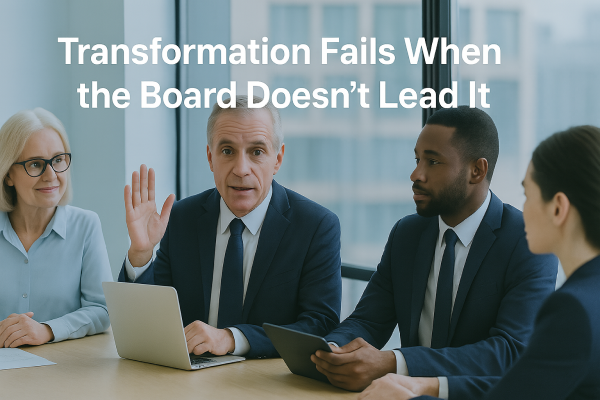
In today’s capital-intensive, high-risk industries, digital transformation has moved beyond the IT department. It’s no longer a technical project—it’s a board-level mandate. And yet, transformation often fails not because the tools are wrong, but because leadership failed to own the direction.
Strategy Without Leadership Is Just Noise
Boards and C-suites frequently express support for “going digital.” Budgets get approved. Consultants are hired. Pilots are launched. But what happens next? Execution is left to middle management. Incentives are misaligned. Roles remain unclear. What began as a strategic ambition becomes a series of disconnected initiatives—and eventually, inertia sets in.
This isn’t about reluctance. It’s about ambiguity. In multi-entity, multi-site enterprises, transformation needs more than approval—it needs active governance, continuous alignment, and visible accountability.
Digital Confusion Is a Governance Problem
When site leaders implement different platforms, when reporting definitions vary between regions, when transformation KPIs are vague or absent—these aren’t operational hiccups. They’re symptoms of board-level disengagement. In the absence of a unified vision, local leaders make local decisions. The result? Fragmentation, inefficiency, and wasted capital.
Digital transformation cannot be delegated like a procurement plan. It must be embedded in the DNA of strategic oversight. If boards don’t lead, transformation loses momentum—and meaning.
Cross-Functional Coordination Starts at the Top
For transformation to succeed, there must be shared ownership across the C-suite:
- The CFO aligns investments to value creation
- The COO ensures processes are ready to adapt
- The CIO orchestrates platforms and data architecture
- And the Board? It sets the tone—and the tempo
In industrial settings—where downtime, compliance, and capital allocation are critical—this orchestration can’t be loose. It must be precise. Boards need to define what success looks like, then monitor and govern it with rigor.

The Real Cost of Passive Oversight
Many boards are still operating with lagging indicators and post-mortem dashboards. But in today’s environment, that’s no longer oversight—it’s exposure. When risks escalate in real time, leaders need live insights. Without that, decisions come too late, and corrective action becomes costlier.
The hidden cost of passive digital governance includes:
- Misalignment across business units
- Inconsistent reporting and accountability
- Delayed reaction to operational risks
- Lost trust in leadership’s ability to drive change
Customer Job (from Value Proposition Canvas)
“Ensure compliance and reduce downtime while gaining operational insight”
Related Pains
- Disconnected systems across sites and entities
- Inconsistent data definitions undermine trust
- Fragmented transformation leads to missed targets
When Governance Is Just Reporting—It’s Already Too Late
Real transformation requires proactive governance. It means asking tough questions early:
- Are we measuring what matters?
- Are our platforms aligned with enterprise outcomes?
- Are digital metrics embedded into board packs?
- Are we driving change—or reacting to it?
Boards must operate with the same agility they expect from their operations. That requires systems, visibility, and clarity—not just commentary.
Conclusion: From Delegation to Ownership
In the next phase of industrial evolution, leadership cannot be optional. The companies that win will be those whose boards lead transformation—not those that simply endorse it. That leadership begins with owning the direction, aligning the enterprise, and embedding transformation into how performance is governed.
If digital is everyone’s project, it becomes no one’s priority. The board must make it everyone’s business—starting at the top.